
One hub, every language your audience reads
An audience that reads three languages used to mean three hubs to build, publish and keep in step, drifting apart the moment one of them was edited. It now means one hub and three languages: add a language, review the draft, and visitors get the hub, its cards and their registration forms in the language they read.
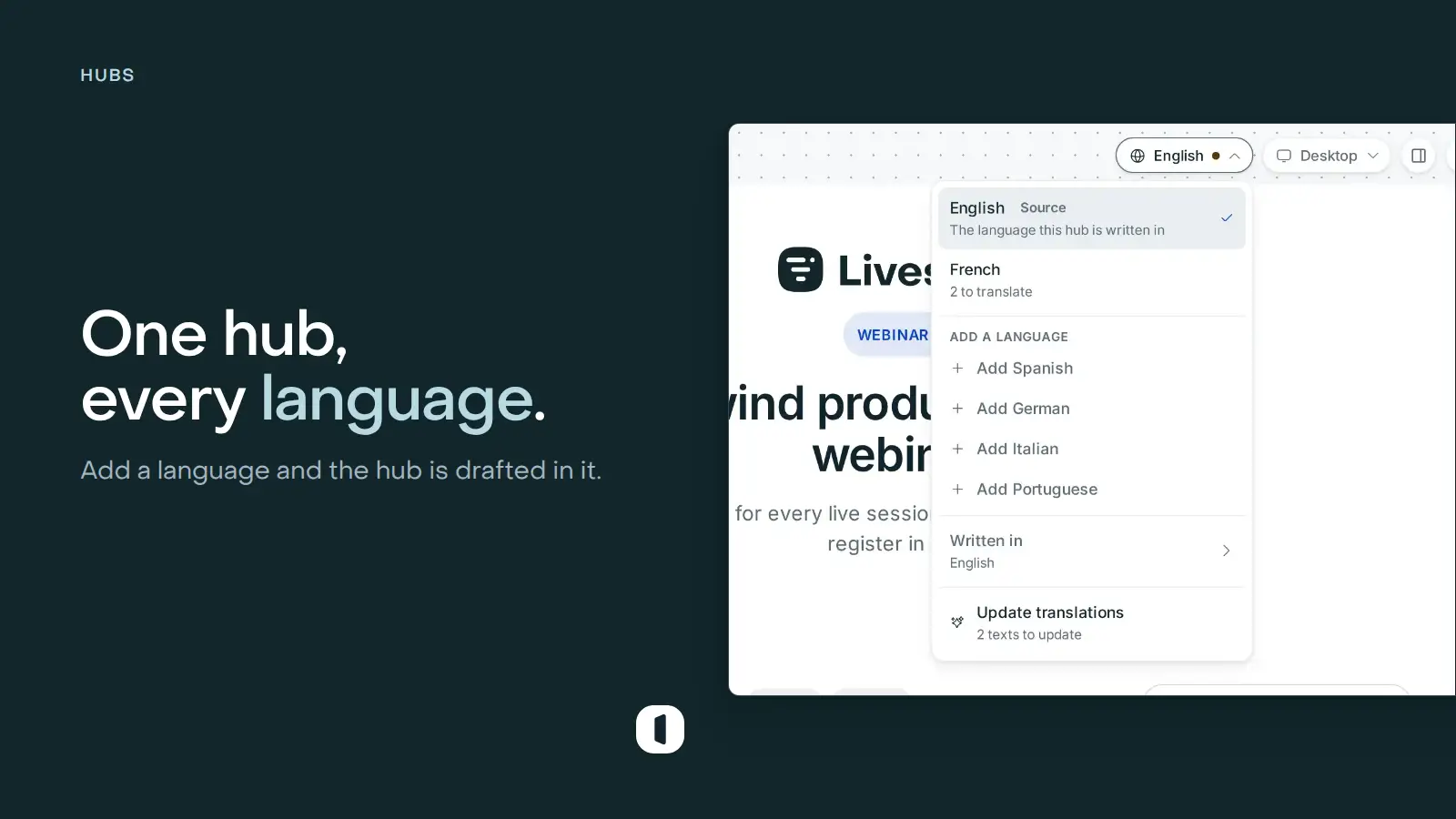
Your visitors read the hub, and its cards, in their own language
The language pill sits at the top of the hub canvas, beside the device pill. Add a language there and AI drafts the hub in it: its headline, its intro, every section’s text. Showing a language turns the canvas into the translated hub, with the same review panel as a page: each text with its source above and its translation below.
The event cards follow. A page you already translated shows its translated name and summary on its card, and its registration form opens in that language. A page you have not translated keeps its own: a hub never hides an event because it is not translated yet.
Because a hub promotes no event of its own, nothing tells it which language it is written in, so you say it: Written in, at the bottom of the language menu, carries that choice. The address without a language suffix serves that version, and the others are translations of it.
Every language has its own address
Each language lives at its own address, such as /your-hub/fr, with its own canonical link and hreflang alternates. Visitors are never redirected: someone whose browser speaks another available language sees a discreet hint in the footer. Embedding a hub offers the same choice, a fixed language or the visitor’s browser.
An automatic collection can also filter on language, so a hub can gather only what you publish in one. Same language as this page makes a single section list the events of whichever language the visitor is reading, at that language’s address.